
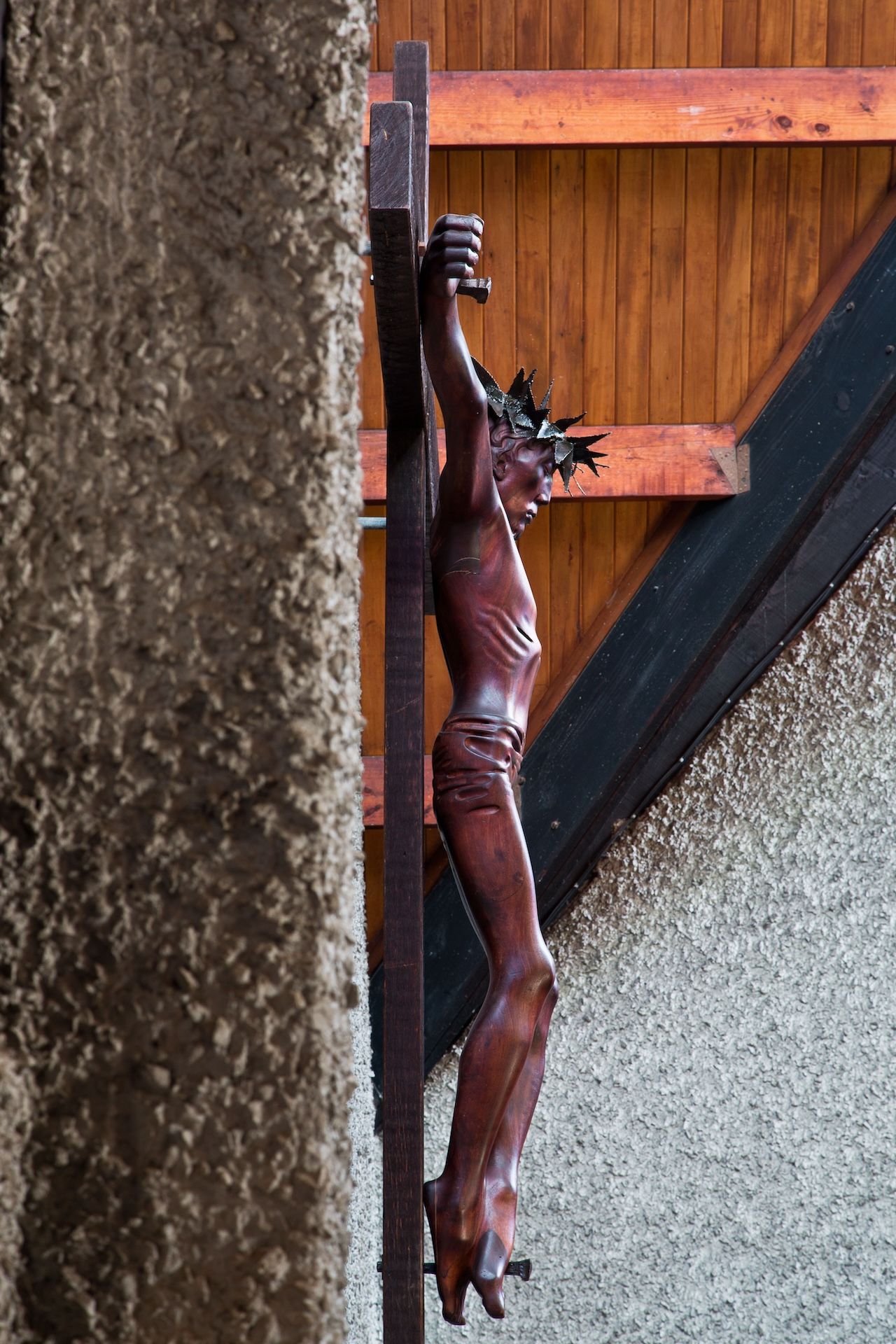
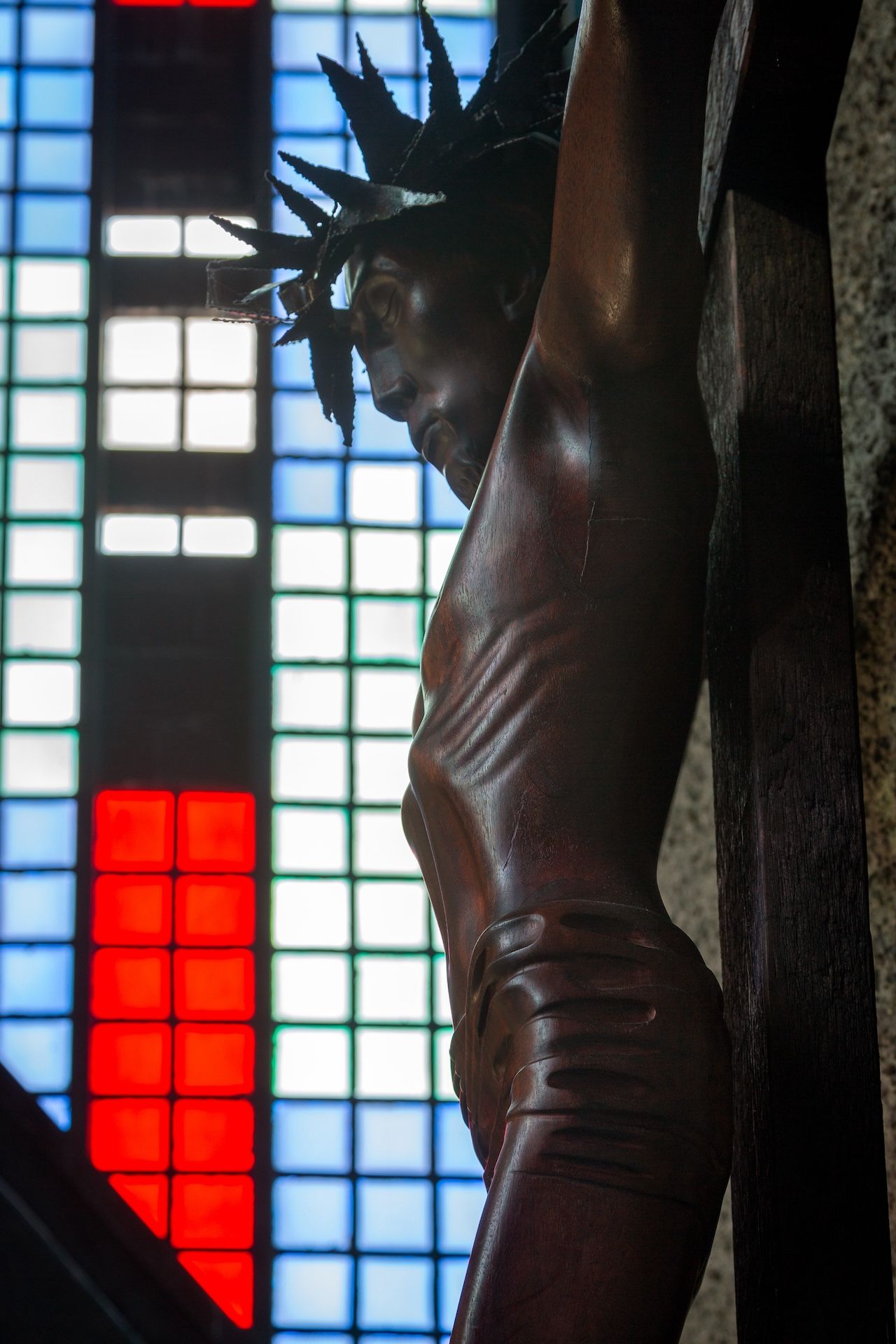
Untitled [Futuna Chapel carved Christ figure]
Jim Allen
2013–Current
- Futuna Chapel, 67 Friend St, Karori, Te Whanganui-a-Tara Wellington
Type
- Sculpture
- Carving
Medium
- Wood
- Steel
- Cast iron
Dimensions
- H1800 × W1600 × D50mm

Jim Allen, Untitled [Futuna Chapel carved Christ figure] (1961), Karori, Te Whanganui-a-Tara Wellington
Image: courtesy Futuna Chapel Trust
- DETAILS
- MAP
Description
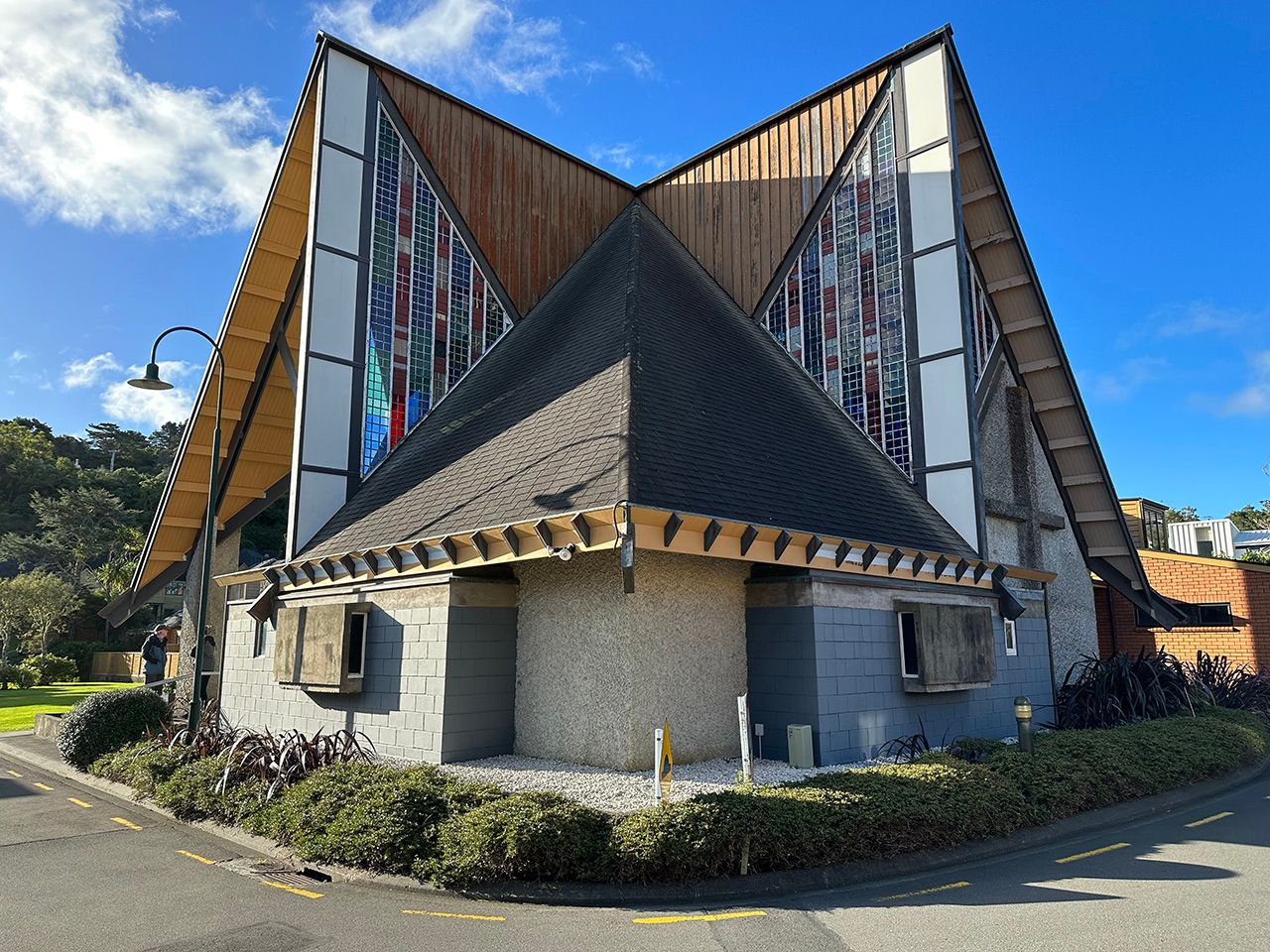
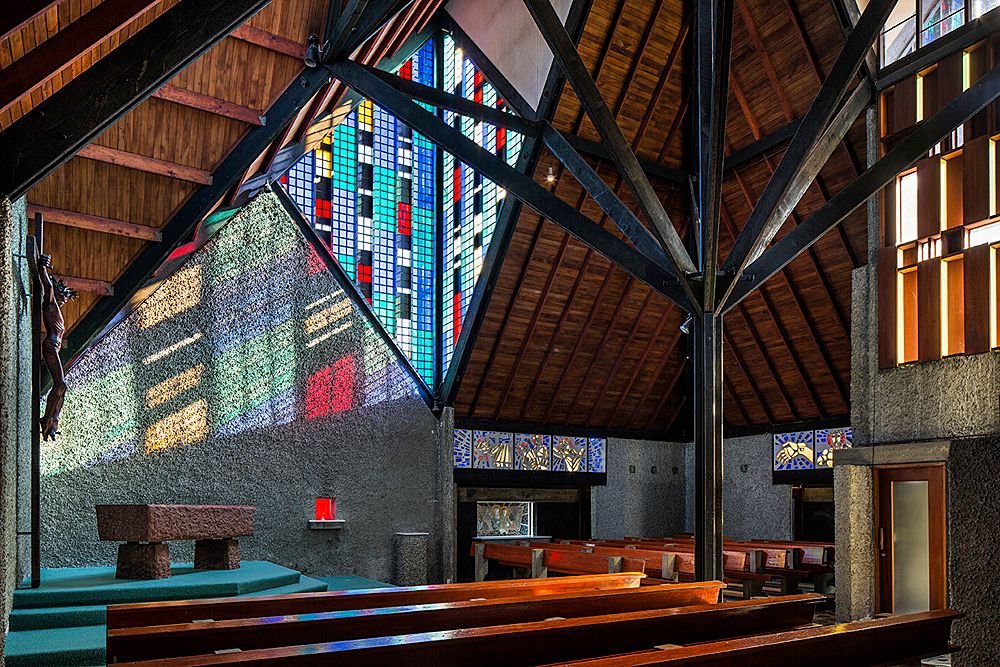
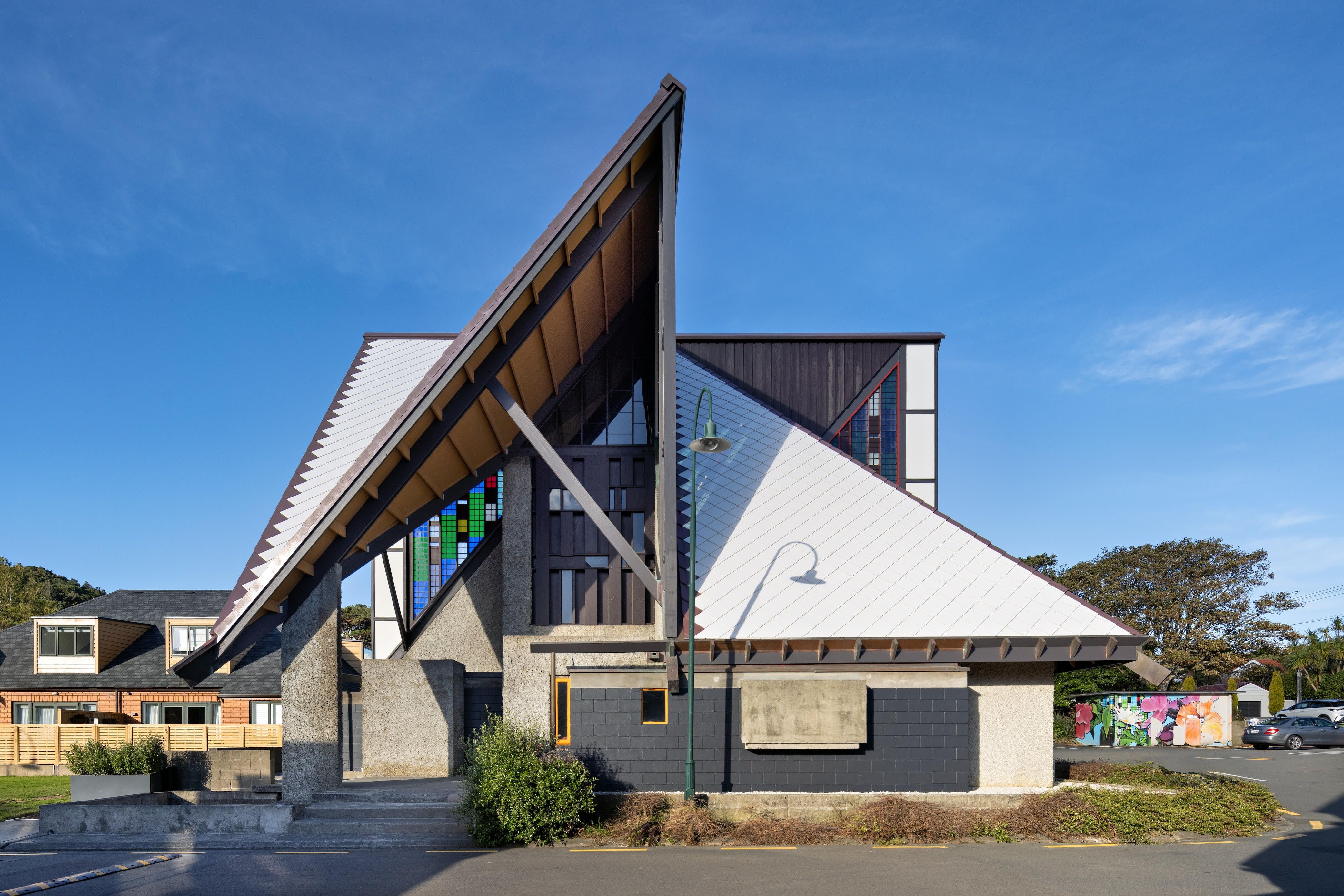
Designed by architect John Scott in 1958, Futuna Chapel is a modernist sanctum and retreat centre built by the Marist Brothers of the Society of Mary. Created as a place for silence and inner renewal, its name commemorates St. Peter Chanel who was martyred on Futuna Island, French Polynesian, in 1841. Construction was undertaken by a team of six Marist brothers led by Brother Joseph Kelly, with volunteers from various Wellington Catholic communities. Scott designed the construction methods so they were within the skillsets of the untrained builders. The chapel was formally opened on 19 March 1961.
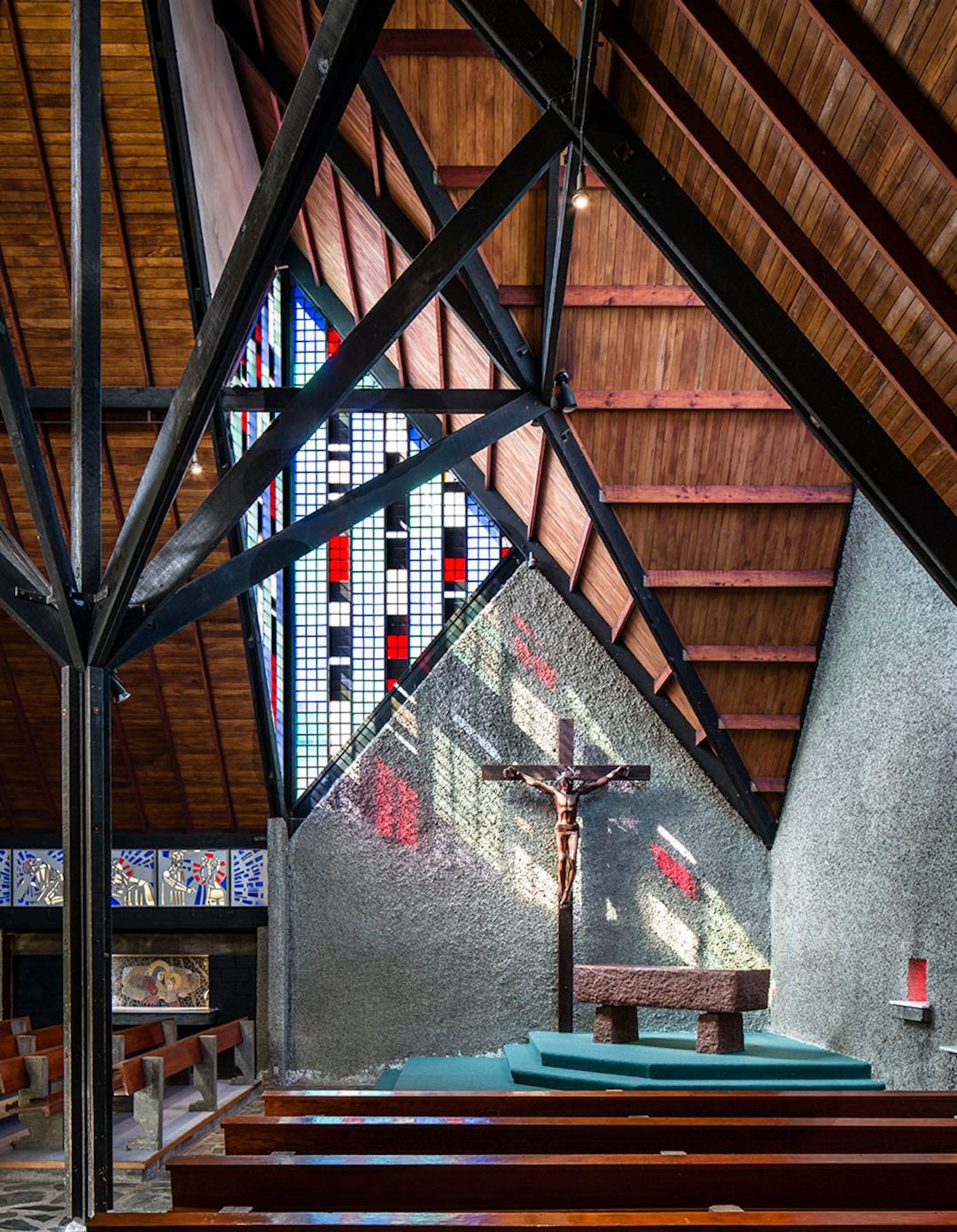
“John Scott’s vision, using clerestory windows set high in a dynamically folded cruciform roof to bathe an unadorned interior in shifting coloured light, was initially challenging for the Marist brothers to accept. The simplicity of the interior layout – two banks of pews at right angles face a rough-hewn granite altar on a corner platform diagonally across from the entrance – belies the emotional power of the room. A small side altar is recessed into each of the four walls. Roof struts radiate from a central post, referencing Māori pou tokomanawa; and exposed rafters and sarking recall vernacular woolshed design.”
Scott and the Society of Mary commissioned Jim Allen to produce four artworks for the chapel, off the back of the pair’s prior collaboration for the Our Lady of Lourdes church in Havelock North (1958). The works for Futuna were Allen’s largest commission at the time, and include coloured windows, Stations of the Cross, a carved Christ figure (seen here), and light modulators.
In 2001, the Society sold the chapel and its surrounding campus to a Wellington property developer who proceeded to replace existing structures with medium-density housing units. The chapel itself was protected from demolition by an urgent change made to the Wellington District Plan by the Wellington City Council.
Concern about the building's future came from many quarters, leading to the establishment of the Friends of Futuna Charitable Trust in 2003. In 2006, following lengthy negotiations, the Trust purchased the chapel and took over its operation and ongoing conservation and maintenance.
Futuna Chapel was awarded the New Zealand Institute of Architects gold medal in 1968, and was the recipient of the inaugural 25-Year Award from the Institute in 1986. It was recognised as a Category 1 Historic Site by The Historic Places Trust in 1999.
–
The Christ figure was carved in laminated mahogany over a period of three months, before being finished with stain and linseed oil. Allen also designed and made the crown of thorns and the three iron spikes that fixed the figure to the cross.
As noted by conservator Carolina Izzo, Allen chose mahogany as the medium to better represent the architect, John Scott’s, intention to have the figure of Jesus represented with the dark tonality of the incarnate skin.
In the early 2000’s, the Christ figure was removed from its cross, and remained missing for twelve years, before being recovered by police in September 2012 on a farm in Ahititi, Taranaki.
The figure was assessed by Shane Pasene at Te Papa Tongarewa Museum of New Zealand and restored by Studio Izzo in 2012-2013. Greer Twiss created a replacement crown of thorns to replace the lost original and the prototype for new iron spikes fashioned from cast iron from the salvaged Wahine anchor chain by a Newtown blacksmith. The reinstalled work was unveiled by Jim Allen and Ema Scott on Sunday 17th March 2013, following a bicultural blessing ceremony.
“Recovering the statue had been a goal of the Futuna Chapel Trust since it was established in 2003 to celebrate, restore and maintain the chapel, which is regarded as one of New Zealand’s modern architectural masterpieces.
“Although the chapel is no longer a consecrated church, the Christ figure was part of Scott’s original architectural vision for the chapel, and its recovery provides a sense of completeness in the restoration of the building.
“Shonagh Kenderdine, the patron of the Futuna Chapel Trust and Chair of the Historic Places Trust Board, said at the time it was replaced in the chapel: “The return of the Christ figure to Futuna has great spiritual, cultural and architectural significance for New Zealanders. The figure is the mauri (life-force) of the chapel. Te Hokinga Mai (the Returning) began today with the figure’s road journey from Taranaki to Wellington under the protection of the New Zealand Police, who have been so instrumental in its return.”
“Jim Allen, who designed and carved the statue in 1961, expressed his delight at its rediscovery. “This is a red-letter day for all of us and brings to a close our endless speculation as to its whereabouts. I look forward to its re-installation and further confirmation of John Scott’s vision for the Futuna Chapel.”
“The statue’s rediscovery came about through the network of the trust, its trustees and patron talking with people. A ceremony to welcome the statue back to its original home was held at the Futuna Chapel in 2012, before it was restored. There was a spirit of celebration, with the return welcomed by kaumatua and kaikaranga as well a priest from the Society of Mary, the original owners of the Chapel. It was an informal ritual of welcome and cleansing across faiths and cultures. After being lost in the wilderness for over a decade, this last significant artefact of John Scott’s original design was returned.
“The costs of fabrication of new crown of thorns, new ‘fixing’ hardware, restoration of the Christ figure and its reinstallation was generously funded by John Scott’s original hardware merchants FL Bone of Hastings and Mark and Wendy McGuinness of Wellington.”
The Chapel is open to the public on the first Sunday of each month.
See also:
- Futuna Chapel [WCC: Wellington Heritage website]
- Futuna Trust [official website]
- Futuna Chapel: Heritage Place Category 1 [Heritage New Zealand listing]
- Jim Allen, Phil Dadson, and Tony Green, The Skin of Years (Clouds & Michael Lett: 2014)
- Nick Bevin and Gregory O’Brien, ‘Futuna: Life of a Building’ (Te Herenga Waka Victoria University Press: 2016)