
Transfiguration
Michael Smither
2006–Current
- Chapel, Anglican Chaplaincy Centre, Ramsay House, Te Herenga Waka Victoria University, 8 Kelburn Pde, Kelburn, Te Whanganui-a-Tara Wellington
Type
- Window(s)
Medium
- Acrylic (Perspex)
- Epoxy resin
- Dye (unspecified)
Dimensions
- H1150 x W1660 x D40mm

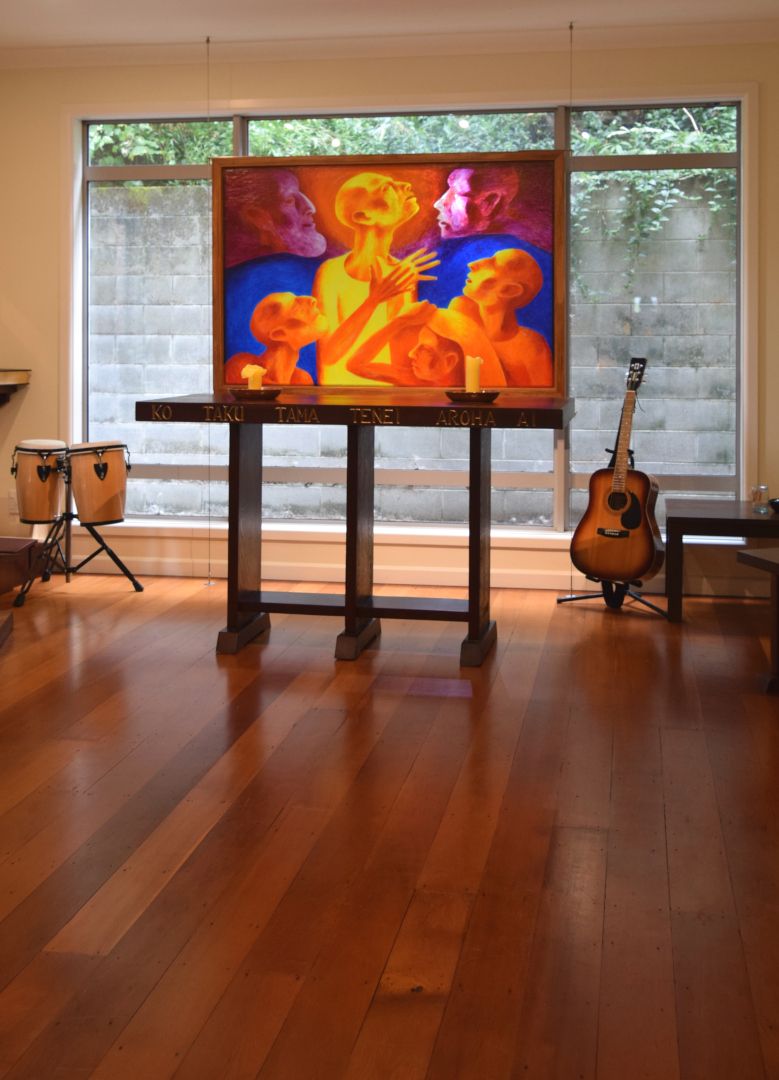
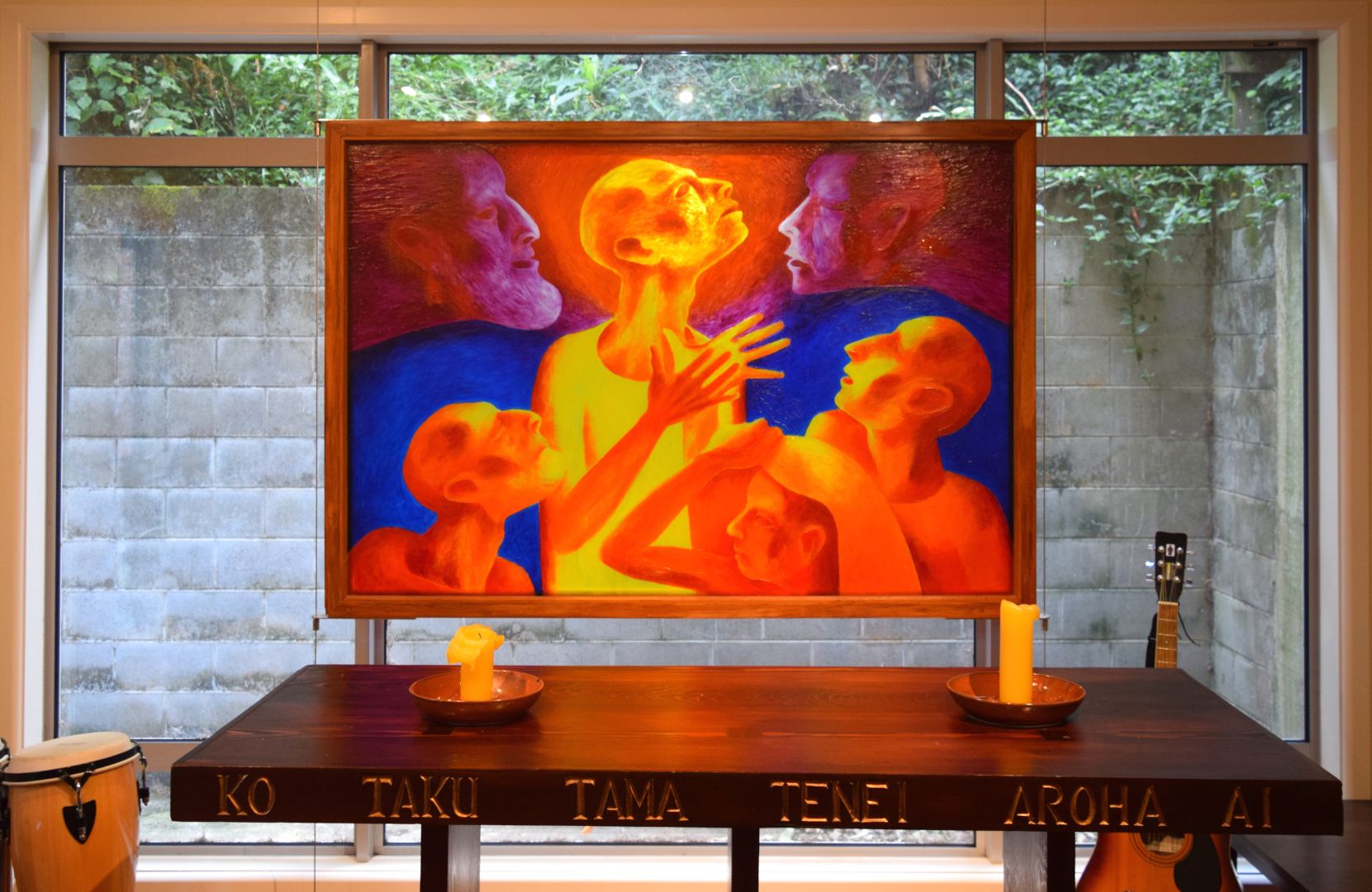
Michael Smither, ‘Transfiguration’ (1967), Chapel, Ramsey House, Te Herenga Waka Victoria University of Wellington, Te Whanganui-a-Tara Wellington
Images: Bronwyn Holloway-Smith, Public Art Heritage Aotearoa New Zealand, 2024
- DETAILS
- MAP
Description
The Anglican Chaplaincy at VUW was founded in 1965, initially operating out of a Church-owned house at 36 Kelburn Parade, with Peter Stuart appointed as inaugural Chaplain. Ramsey House was named after the then-Archbishop of Canterbury, Michael Ramsey.
Stuart commissioned Michael Smither to do the work and it is said he paid the young, broke artist $100, plus board. Michael slept at the chaplaincy while completing the work.
In 1970, Peter Stuart wrote of this painting, "Richly textured, vivid in colour yet translucent, it hangs as the Chapel’s focal point behind the Lord’s table, blazing its light across it.
“The central figure is, of course, Christ. He is flanked by Moses and Elijah; the three lower figures are the disciples James, Peter (shrinking away), and John (the one contemplating the transfigured Christ).
"Some years ago I called Michael to discuss the painting with him. He remembered it well even though many years had passed since he had completed it. He had camped out at the Chaplaincy for weeks to do the work, taking little for his labours except a few dollars and basic keep - it was a labour of love and passion, like the painting itself and the event it seeks to capture. And it turned out also to be a painting of distinctive vision…
“I was a young and unknown as a painter and had things to say”, Michael told me, “I was trying to express the passion and struggle of the disciples' experience compared to the very careful and domesticated way we often see them.”
“Michael sees The Transfiguration as a sister piece to his depiction of Jesus driving money lenders from the Temple, another provocative work which he painted at the time and now hangs in VUW Commerce Faculty - “keeping them honest”.
Source: 2006 Sermon David Newton (priest chaplain 1999 - 2010), Feast of the Transfiguration.
The first iteration of the painting was done on glass, but three weeks after starting the work, it shattered with the drying of the glass. Smither then began again but this time on perspex.
This work continued to have its struggles. Some people found it overwhelming and wanted it banned from a place of prayer and reflection.
To solve this problem at 36 Kelburn Parade, the work was placed in a lightbox, to be turned on or off at will.
The Chaplaincy was demolished along with other houses to make way for the Von Zedlitz building in 1978 and the work was put into storage in the garage of the Catholic Chaplaincy, and later moved to the Rankin Brown basement for storage c2000.
Chaplain David Newton commenced a $1million fundraising and building programme to renovate the new chaplaincy at Ramsey House and build the adjoining chapel in the former backyard. Smither’s work, now in a state of disrepair, was brought out of storage to be reinstalled in the new chapel along with the original furniture including the altar, pews, and fittings. Roger (a faculty member) and Ruth Hopkins donated the funds for the restoration and rehanging of the work, with Carolina Izzo completing restoration in 2006. A plaque is installed near the work recording this. Kate Schick & Ben Thirkell-White also donated funds towards the new Chaplaincy restoration.
The work is hung behind a wooden altar that was designed to accompany it. Inscribed on one side was: “This is my beloved son”. In 2006 at the time of the restoration, a Te Reo inscription was added to the other side: “Ko Taku Tama Teni Aroha Ai”.
According to Assistant Bishop, Eleanor Sanderson, “the Transfiguration was chosen by him [Rev Peter Stuart] because of the resonance that it had in the sense of light in the University setting as the light of Christ and also because of the link of the Transfiguration story in the work of Archbishop Michael Ramsey, the Archbishop of Canterbury at the time. The task was given to the young Michael Smither to paint the Transfiguration, and he painted it in a way that expressed fear, starkness and the glory of God in quite a confronting way, a way that he perceived fitted with the University context.”
See also:
- Stuart, P., 2016, ‘The story of the foundation of the Victoria University, Wellington, Anglican Chaplaincy’, Journal of the TCMA, vol. 6, no. 1, pp. 1-10. Published online 1 May 2016. Downloaded from www.TCMAJournal.org)